South Florida Board Reference

Frequently Asked Questions

The questions boards and property managers ask most often, answered plainly. Building-specific scope requires a direct review.

Updated
September 4, 2026
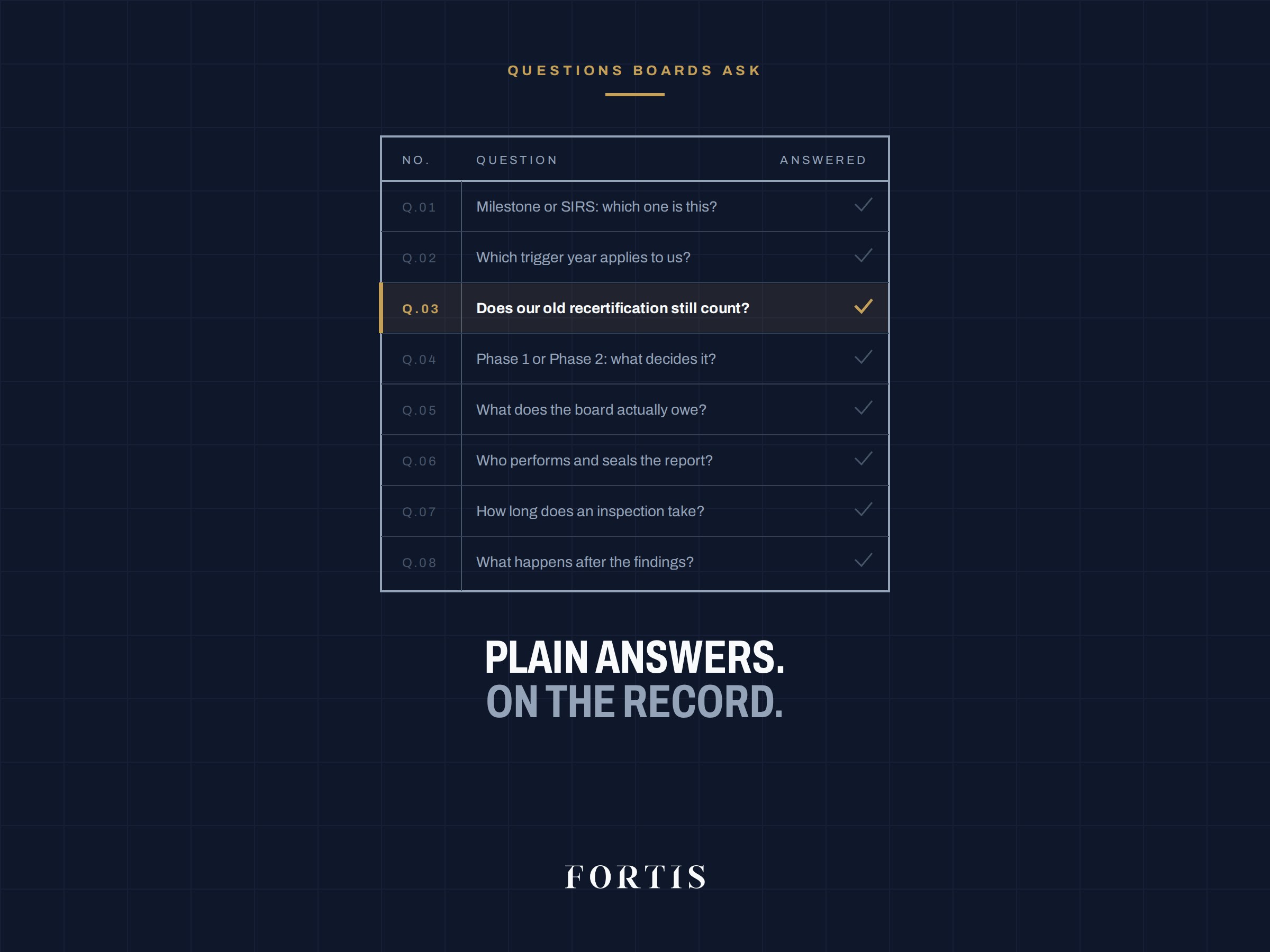
Ledger of eight questions condominium boards ask about milestone inspections, SIRS and recertification, each marked answered.

01

What Boards Ask

Direct answers on inspection triggers, overlapping requirements, timing and professional responsibility.

Milestone Inspections

Triggers, phases and timing under F.S. §553.899.

  1. When does my building need a milestone inspection?

    A milestone inspection is due when a condominium or cooperative building of three or more habitable stories reaches 30 years from its Certificate of Occupancy date — or 25 years where the local enforcement agency has adopted the earlier trigger, as Broward County has countywide — and every 10 years after that. Fortis confirms the trigger that applies to your building and its jurisdiction before any fieldwork is scheduled.

  2. What is the difference between Phase 1 and Phase 2 of a milestone inspection?

    Phase 1 is a visual inspection of the building’s structural systems and load-bearing elements by a licensed engineer or architect. There is no pass or fail: the sealed report states the findings and whether substantial structural deterioration was observed. Only if it was does Phase 2 follow, within 180 days of the Phase 1 report, adding testing and more detailed structural analysis.

  3. Which Florida jurisdictions use the 25-year milestone trigger instead of 30?

    Thirty years from the Certificate of Occupancy is the statewide default under §553.899(3). Twenty-five years applies only where the local enforcement agency adopted it under §553.899(3)(b): Broward County countywide; Miami-Dade for qualifying coastal condominiums and cooperatives inside the county’s 3-mile zone; and in Palm Beach County, Boynton Beach, Highland Beach and part of Boca Raton. Florida keeps no registry of these adoptions, so Fortis maintains a jurisdiction-by-jurisdiction record and a deadline calculator.

Structural Integrity Reserve Studies

Scope and cycle under F.S. §718.112.

  1. What’s the difference between a milestone inspection and a Structural Integrity Reserve Study (SIRS)?

    A milestone inspection is a structural inspection of the building’s load-bearing elements under §553.899, Florida Statutes, tied to the Certificate of Occupancy date. A Structural Integrity Reserve Study is a reserve-funding study of the eight required components under §718.112(2)(g)1, tied to the creation of the condominium on a 10-year cycle. They are separate requirements with separate clocks, and most condominium associations owe both.

  2. What must a Structural Integrity Reserve Study include?

    Florida law lists eight components: the roof; the structure, including load-bearing walls and other primary structural members and systems; fireproofing and fire protection systems; plumbing; electrical systems; waterproofing and exterior painting; windows and exterior doors; and any other item whose deferred maintenance or replacement cost exceeds $25,000 or the inflation-adjusted amount determined by the Division, whichever is greater, and whose deferred maintenance or replacement would negatively affect the other seven listed components. The visual inspection portion must be performed by a licensed engineer or architect, and the study must include a funding analysis.

County Recertification

Broward, Miami-Dade and Palm Beach programs.

  1. Does my county require 25-year or 30-year building recertification?

    In Broward County, the Building Safety Inspection Program begins at 25 years from the Certificate of Occupancy and repeats every 10 years. In Miami-Dade County, recertification generally begins at 30 years (25 years for qualifying coastal condominiums and cooperatives) and repeats every 10 years. In both counties the county building department is also the local enforcement agency for the state milestone inspection under §553.899, so the recertification program is how that requirement is administered and satisfied: one inspection process, covering structural and electrical systems, not two. Outside Broward and Miami-Dade, the state milestone inspection applies on its own. Fortis confirms which process and which trigger apply to your specific building.

  2. Does Palm Beach County have a building recertification program?

    No. Palm Beach County has not adopted a countywide, age-triggered recertification ordinance like Broward’s or Miami-Dade’s. Buildings there follow the state milestone inspection under §553.899 as enforced by the municipal or county building department with jurisdiction, and some cities have adopted the 25-year trigger. Fortis confirms which authority and which trigger apply to your specific building.

Process, Fees and the Fortis Standard

Who seals the work, what it costs and what to prepare.

  1. Who signs and seals Fortis’s inspection reports?

    Every Fortis inspection is performed and sealed to the Fortis Standard — one documented process, reviewed and sealed by a licensed Florida PE in direct responsible charge, regardless of which engineer is in the field.

  2. How much does a milestone inspection or recertification cost?

    Fees depend on the building’s size, height, age, access and the scope the county or statute requires — a single-building Phase 1 and a multi-building association are very different engagements. Fortis provides a written proposal with a defined scope, fee and schedule before any fieldwork begins, for buildings across Broward, Miami-Dade and Palm Beach.

  3. How long does an inspection take, and when do we receive the report?

    Most engagements move from signed agreement to submitted report in two to five weeks. Phase 1 fieldwork typically takes one to three site days depending on building size, followed by two to four weeks of report preparation and engineering review. Recertification adds the electrical inspection to the same visit sequence. Fortis states the schedule in the proposal and presents the sealed findings to the board.

  4. What should we have ready before contacting Fortis?

    The building or association name and address, the Certificate of Occupancy date if known, any county notice or prior inspection report, and the name of the board or management contact. That is enough for Fortis to confirm which requirement applies and return a written scope within one business day.

Fortis provides Florida PE-led engineering under one documented standard: the Fortis Standard.

Next Step

Need an answer for your building?

Fortis reviews the building facts and identifies the requirement that applies.